
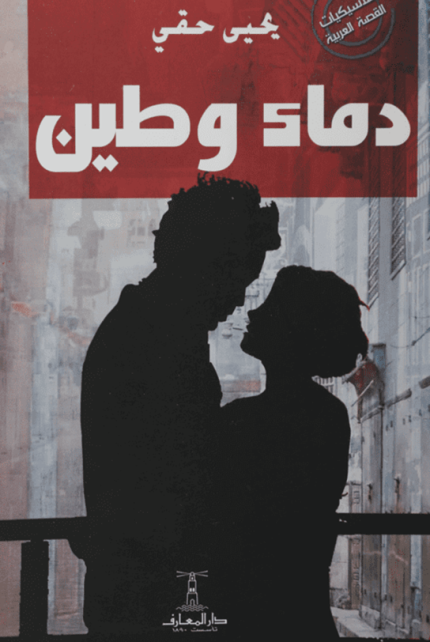
دماء وطين
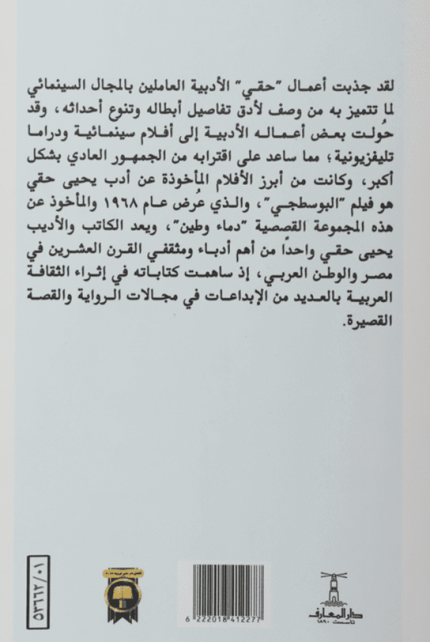
35.00 AEDyahya Haqqi’s Literature works have attracted filmmakers due to their detailed descriptions of characters and diverse events. Some of his literary works have been adapted into films and television dramas, which helped him connect with a larger audience. One of the most prominent films based on Yahya Haqqi’s literature is “Al-Bosaty,” which was released in 1968 and adapted from the short story collection “Dama’ wa Tayyin” (Blood and Clay). The writer and intellectual Yahya Haqqi is considered one of the most significant authors of the 20th century in Egypt and the Arab world. His writings have enriched Arab culture with numerous creative contributions in the fields of novels and short stories.

رحلة إلى جهنم
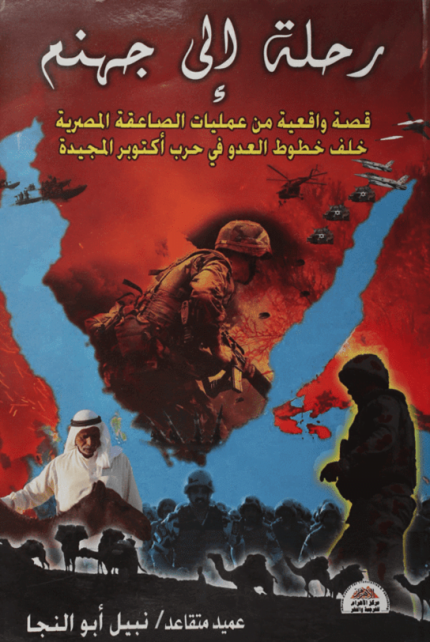
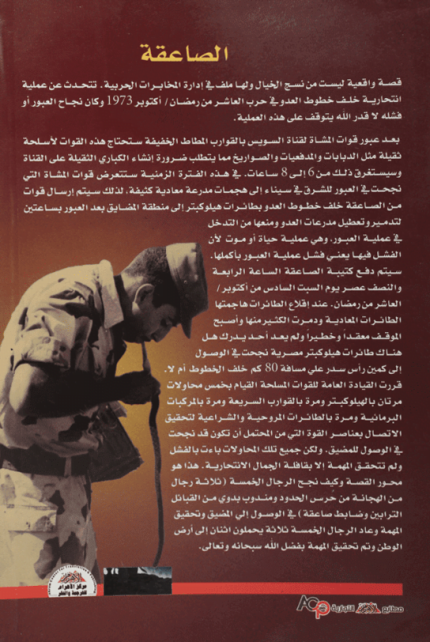
55.00 AEDA True Story, Not a Product of Imagination, with a File in Military Intelligence. It tells of a suicide mission behind enemy lines during the October 6th War in 1973, where the success or failure of the crossing depended on this operation.
After the infantry forces crossed the Suez Canal using lightweight rubber boats, they needed heavy weapons such as tanks, artillery, and missiles, requiring the construction of heavy bridges over the canal, a process that would take 6 to 8 hours. During this time, the infantry forces that successfully crossed to the east of Sinai would be subjected to heavy enemy armored attacks. Therefore, a unit from the ‘Saaqa’ (Thunderbolt) forces would be sent behind enemy lines by helicopters to the ‘Madaa’iq’ area, two hours after the crossing, to destroy and disable enemy armored vehicles and prevent them from interfering in the crossing operation. This was a life or death operation because failure in it would mean the failure of the entire crossing operation.
The ‘Saaqa’ unit would depart at 4:30 PM on Saturday, the 6th of October (10th of Ramadan). As the helicopters took off, they were attacked by enemy aircraft, and many of them were destroyed, making the situation complicated and dangerous. Nobody knew if any Egyptian helicopters managed to reach the ambush site in Ras Sudr, 80 km behind the enemy lines.
The General Command of the Armed Forces decided to make five attempts: two by helicopters, one by speedboats, one by amphibious vehicles, and one by gliders, to make contact with the forces that might have succeeded in reaching the strait. However, all these attempts failed, except for the suicide camel caravan.
This is the core of the story, and how the five men (three from the border guards, a tribal representative from Bedouin tribes, and a ‘Saaqa’ officer) managed to reach the strait, fulfill the mission, and then return home. Three of them carried two others back to the homeland, and the mission was accomplished, thanks to God Almighty.
سنوات الخماسين
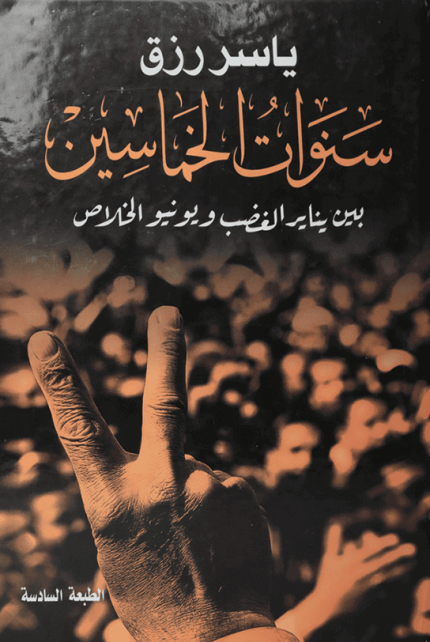
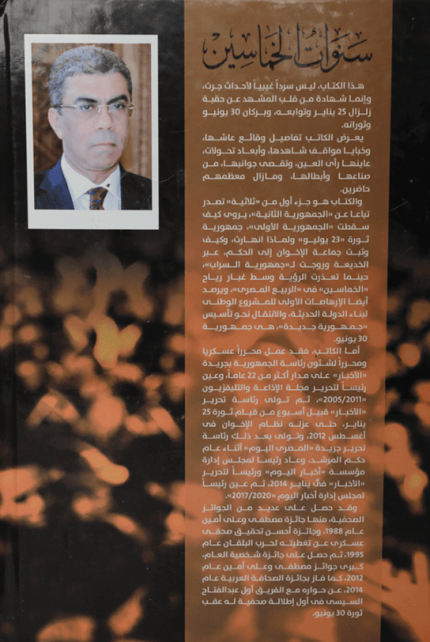
110.00 AEDThis book is not just a narrative of events; it is a testimony from the heart of the scene about the era of the earthquake on January 25th and its aftermath, as well as the volcanic eruption on June 30th and its aftermath. The author presents details of experiences lived, the hidden aspects of witnessed situations, and the dimensions of transformations that he observed closely, covering all aspects from their makers to the heroes, most of whom are still present.
The book is the first part of a trilogy to be successively released by “The Second Republic.” It narrates how “The First Republic” fell, the July 23rd Revolution Republic, and why it collapsed. It also sheds light on how the Muslim Brotherhood deceived and propagated the “Illusory Republic” when visibility was obscured amidst the dust of the “Khamasin” winds during the “Egyptian Spring.” Furthermore, it also captures the initial flashes of the national project to build the modern state and transition towards establishing the “New Republic,” the June 30th Republic.
As for the author, he worked as a military editor and presidential affairs editor for “Al-Ahram” newspaper for over 22 years. He was appointed as the editor-in-chief of the Radio and Television Magazine “2005/2011,” then took over as editor-in-chief of “Al-Ahram” newspaper a week before the January 25th Revolution, until he was removed by the Muslim Brotherhood regime in August 2012. After that, he became the editor-in-chief of “Al-Masry Al-Youm” newspaper during the rule of the Brotherhood leader. Later on, he returned as the chairman of the board of directors of “Akhbar Al-Youm” foundation and the editor-in-chief of “Al-Akhbar” in January 2014, and was appointed as the chairman of the board of directors of “Akhbar Al-Youm” from 2017 to 2020.
He has received numerous journalism awards, including the Mustafa and Ali Amin General Secretariat Award in 1988, the Best Military Journalism Award for his coverage of the Balkan War in 1995, and the Person of the Year Award, one of the major Mustafa and Ali Amin General Secretariat awards, in 2012. He also won the Arab Journalism Award in 2014 for his interview with Field Marshal Abdel Fattah El-Sisi in his first press appearance after the June 30th Revolution.
ضرب الاسكندرية
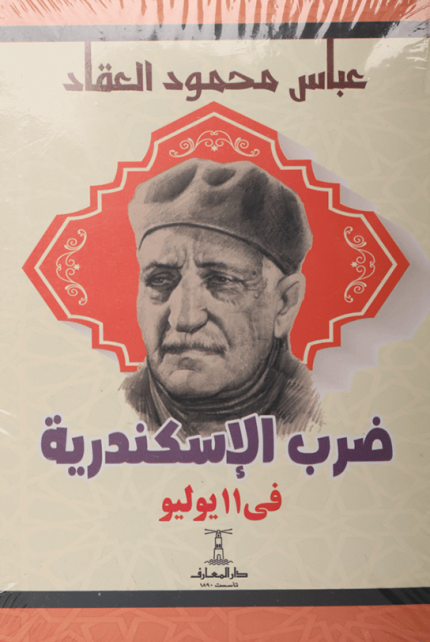
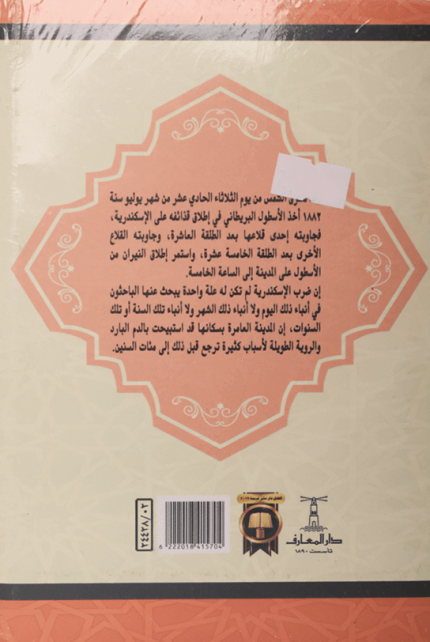
40.00 AEDOn Tuesday, the eleventh of July 1882, the British fleet began shelling Alexandria. One of its fortresses responded after the tenth shot, while the other fortresses answered after the fifteenth shot. The naval bombardment of the city continued until five o’clock. The bombing of Alexandria was not caused by a single reason, as researchers have sought answers in the news of that day, that month, and even those years. The bustling city, with its inhabitants, fell victim to cold-blooded violence and a long premeditated plan for various reasons, some of which date back hundreds of years.
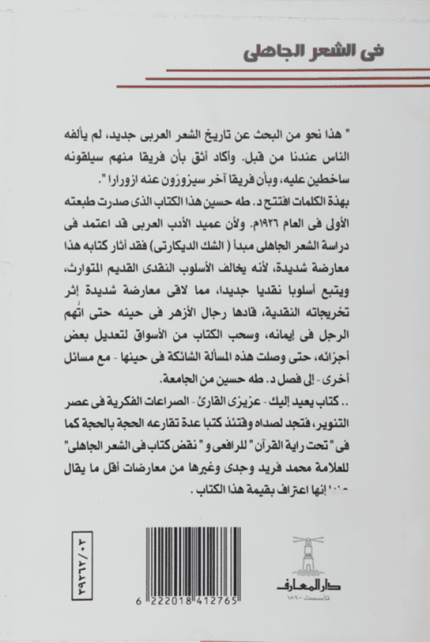
في الشعر الجاهلي
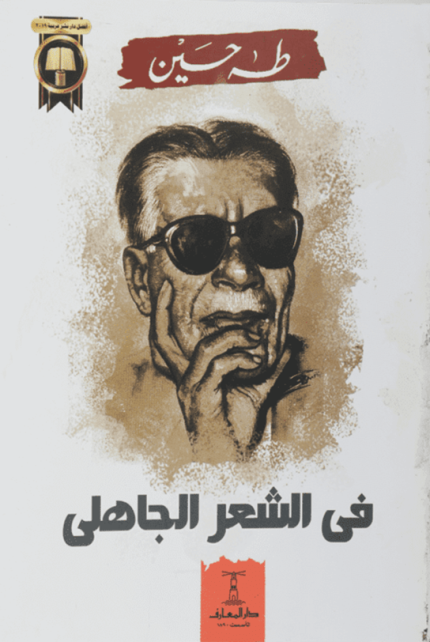
40.00 AEDWith these words, Dr. Taha Hussein opened this book, which was first published in 1926. This is a new approach to researching the history of Arabic poetry, never attempted before in our society. I almost trust that some will criticize it angrily, while others will visit it with admiration. The book’s content raised strong opposition because Dr. Taha Hussein adopted the principle of Cartesian doubt in studying pre-Islamic poetry, departing from the traditional inherited critical style and adopting a new critical approach. This faced severe opposition from scholars of Al-Azhar at that time, leading to accusations against the author’s beliefs and the withdrawal of the book from the markets for some modifications. This controversial issue, along with others, resulted in Dr. Taha Hussein’s dismissal from the university. The book returns to you, dear reader, the intellectual conflicts of the Enlightenment era, where you will find several books contending against it, like ‘Under the Banner of the Qur’an’ by Al-Rafii and ‘Refuting a Book on Pre-Islamic Poetry’ by Muhammad Farid and Jad. These critiques are, at the very least, an acknowledgment of the value of this book.
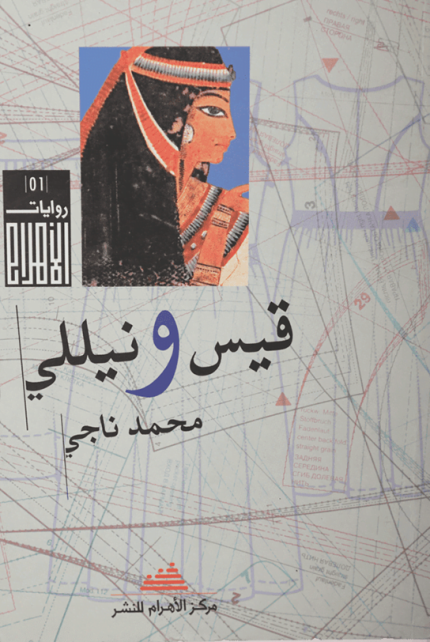
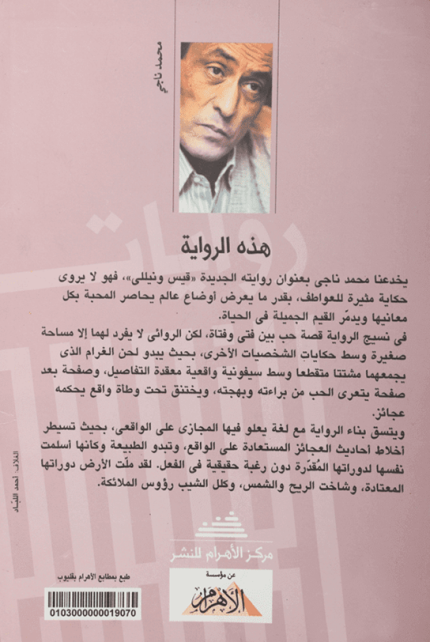
قيس ونيللي
40.00 AEDMohamed Nagy deceives us with his new novel “Qais and Nelly.” He does not narrate an emotionally stirring story as much as he presents the conditions of a world that besieges love in all its meanings and destroys the beautiful values in life. Within the novel, there is a love story between a boy and a girl, but the author only allocates them a small space amidst the tales of other characters. The melody of love that binds them seems scattered and interrupted amidst the complex realism of details. Page after page, love is stripped of its innocence and joy, suffocating under the weight of a reality governed by the elderly.
The structure of the novel is consistent with a language where metaphors dominate the real, as if the reminiscences of the elderly control reality. Nature appears to have surrendered itself to its preordained cycles without any genuine desire to act. The earth has grown tired of its customary cycles, and the wind and sun have aged, and the angels’ heads have been crowned with gray hair.
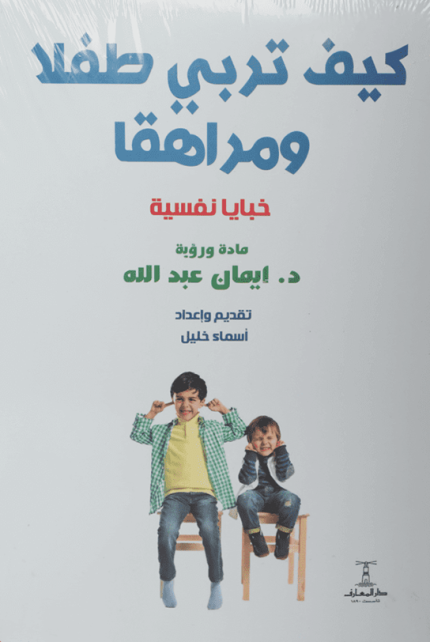
كيف تربي طفلاً ومراهقاً
50.00 AEDThis is a book that sheds light on the importance of parenting and raising teenagers, not just to bestow the title of parenthood or list them as children on official papers, but to play a positive and essential role. When we choose to bring children into this world, we are responsible for guiding, directing, and educating them. We are accountable for everything we provide for ourselves and our loved ones.
This book is an educational gift for anyone interested in the subject, as it contains guidance on raising children in a socially balanced manner, by training parents on effective ways to interact with their children and implementing positive parenting methods. It also addresses the most significant challenges children and teenagers face and how to handle these critical stages, offering insights into recognizing and dealing with their psychological disorders.
The book covers dangerous phenomena such as suicide, behavioral addictions, and the risks of technology on children and family life. It delves into the mysteries and secrets of childhood and adolescence, as well as the family’s role in understanding and managing them. It takes readers on a journey into the minds and hearts of their children, encouraging them to learn effective parenting approaches with positive awareness, fostering strong psychological foundations for their little world.
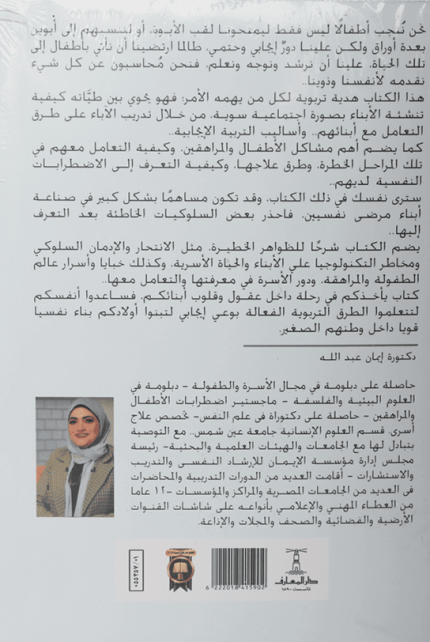
Dr. Eman Abdullah holds a diploma in family and childhood studies, environmental sciences, and philosophy. She has a master’s degree in child and adolescent disorders and a doctorate in psychology with a specialization in family therapy. She is a faculty member at Ain Shams
University, in the Department of Humanities. She recommends sharing her work with universities, scientific institutions, and research centers. As the head of the board of directors of the Eman Foundation for Psychological Counseling, Training, and Consultations, she has conducted numerous training courses and lectures in various Egyptian universities, centers, and institutions. With 12 years of professional and media contribution across terrestrial and satellite channels, newspapers, magazines, and radio, she has made a significant impact in the field.”
Note: The translation provided above is a summary of the text provided. For the full text or more accurate translations, a professional translator is recommended.
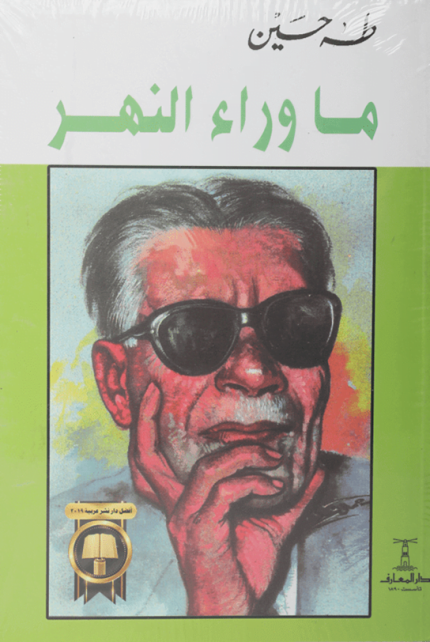
ما وراء النهر
40.00 AEDTaha Hussein says, “I prefer to establish a sort of fellowship between me and the readers, so that we start the story together, proceed in it together, and conclude it together. Sometimes we agree, and sometimes we differ.”
With these words, Taha Hussein lays the foundation for the relationship between him and the readers of his novel, presenting a literary text characterized by interactivity, blending valuable philosophical elements, and offering a distinctive presentation of the social conflict beyond the river. This is a class struggle, manifested in the oppression of the rich over the poor and the forces that coerce the weak. Beyond the river, there are people who do not deny injustice; rather, they subjugate their weak counterparts, a matter rejected by our great writer who was always concerned with establishing the values of citizenship and social justice.
In this novel, he advocates for reform and holding onto the ray of hope despite the dark shadows. Moreover, he intentionally leaves the ending open, allowing the text to interact with its readers and enabling them to discover what lies beyond the river on their own.
مختارات من داود بركات
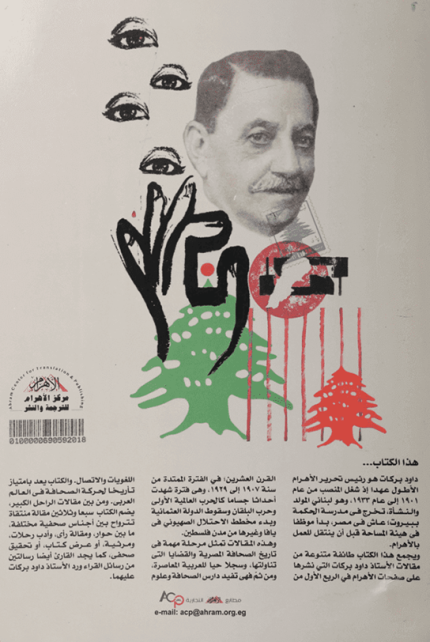
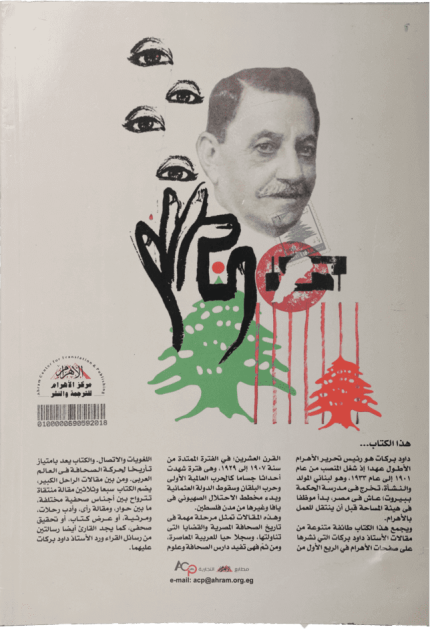
55.00 AEDDawood Barakat was the longest-serving editor-in-chief of Al-Ahram, holding the position from 1901 to 1933. He was of Lebanese origin, born and raised in Lebanon, and graduated from Al-Hikma School in Beirut. He lived in Egypt and initially worked as a civil servant in the Survey Authority before joining Al-Ahram.
This book brings together a diverse collection of articles by Professor Dawood Barakat, which were published in Al-Ahram during the first quarter of the twentieth century, spanning from 1907 to 1929. This period witnessed significant events, such as World War I, the Balkan Wars, the fall of the Ottoman Empire, and the beginning of the Zionist occupation plan in Jaffa and other cities in Palestine. These articles represent an important phase in the history of Egyptian journalism and the issues they addressed. They serve as a living record of contemporary Arabic and are particularly valuable for researchers in journalism, linguistics, communication, and related fields. The book, in essence, serves as a historical account of the press in the Arab world.
Among the writings of the late great writer, the book includes thirty-seven selected articles covering various journalistic genres, including interviews, opinion pieces, travelogues, eulogies, book reviews, and investigative journalism. Additionally, the reader will find two letters from readers and Professor Dawood Barakat’s responses to them
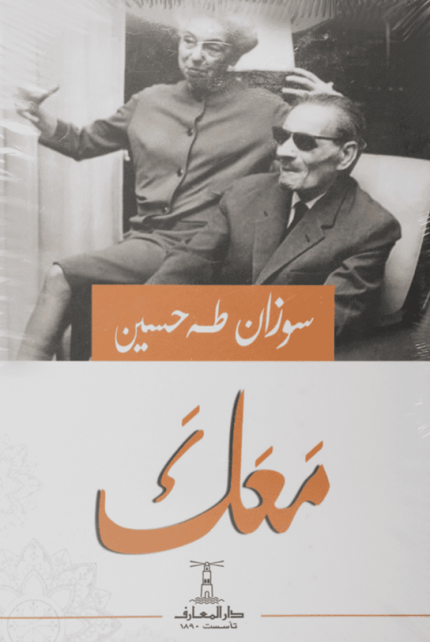
معك
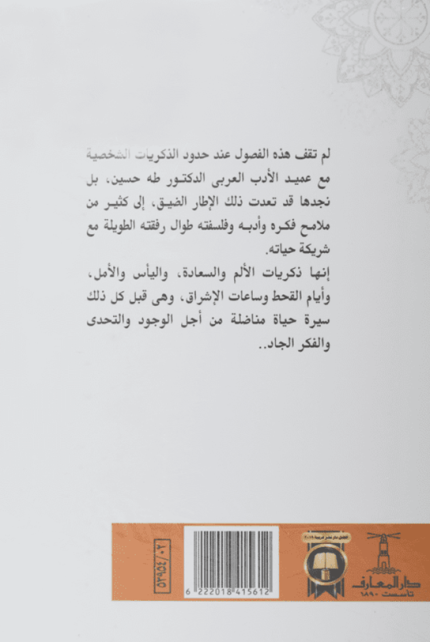
25.00 AEDThese chapters did not stop at the boundaries of personal memories with the dean of Arab literature, Dr. Taha Hussein. Instead, they extended beyond that narrow framework to encompass many aspects of his thoughts, literature, and philosophy throughout his long companionship with his life partner. These are memories of pain and happiness, despair and hope, days of scarcity and moments of enlightenment. Above all, they represent the biography of a fighter for existence, challenge, and serious thought.